In this blog entry, I’ll cover the Honda CRV 2nd generation. This is a special request by one of my loyal reader. The CRV’s on sale in Malaysia from 2001 to 2006. It’s Locally assembled in Malacca and priced at RM146,000 when new. Here’s the used car prices as at 10/10/2008.
Year: 2001 2002 2003 2004 2005 (Facelift) 2006
Price:RM65k RM70k RM78k RM84k RM96,000 RM105,000
What to look out for:
See "Owner's Review".

As usual, I don’t have a car to test and/or brag about. Hence, I dished out a “Supertest” from GOAUTO Australia.
MSN Auto Averaged user and/or owner rating (by 500 owners)
Source: http://autos.msn.com/research/vip/overview.aspx?year=2002&make=Honda&model=CR-V
User Reviews
8.7 Overall Rating
8.8 Styling
8.6 Performance
8.4 Interior
8.9 Quality
8.7 Recommendation
Source (a) – see references at the end of this review.
Model release dates: December 2001 - October 2003
Overview

HONDA's new-for-2002 CR-V has plenty to live up to. Coming on the back of a host of capable new alternatives and amid sliding overall sales, the 2002 model is the successor to the original that became Australia's top-selling compact off-roader. The all-new CR-V continues the tried-and-proven formula pioneered by its popular predecessor, with a very familiar, slightly more aggressive and angular bodyshell design that is both bigger and heavier. There's a more powerful engine to compensate, however, as well as what Honda claims are significant improvements to ride, handling and safety. The new CR-V is crisper, cleaner and even further refined, even if it's slightly low-key compared to some of its rivals.

It wasn't the first compact four-wheel drive wagon, having been beaten by compatriots Toyota RAV4 and Suzuki Vitara, but the original CR-V has been Australians' "soft-roader" of choice for the past three years. Released almost five years ago, the original was facelifted in March 1999.
The Car

MORE evolution than revolution, Honda's all-new CR-V has a pronounced V-shaped front-end that emphasises its revised grille and headlights. A high level of imitation chrome-plating is used on the grille and large central Honda badge, while the large cat-like headlight assembly, which incorporates turn indicators and park lights, is integrated with the front quater panel, bonnet and deeply sculpted bumper. The vehicle's overall dimensions have increased, along with the front track (distance between the wheels), which gives the CR-V greater road presence. Stronger lines and blunt edges around the bonnet and along the doors add to the rugged appearance without effecting CR-V's refined look. A stylish roof-rail runs the length of the roof gutter and turns down to meet the rear tail-light, which is mounted high on the D-pillar for good visibility.
The Car - Seat Plan
HONDA claims the CR-V's cabin space has increased by eight per cent. The high-mounted front and rear seating areas have plenty of head and legroom and the vehicle has generous window space all around. The centre console is still a foldable tray table, leaving enough room for front occupants to walk through to the rear. The walk-through facility limits the number of storage areas, which are nonetheless adequate in the standard CR-V - the Sport model adds seatback pockets. Sport and base models come with individual driver and front passenger armrests (automatic only) and the rear seat has a shared fold-down centre armrest with cupholders that can be used when the centre seat is free.
The Car - Seats

CR-V was among the first light-duty, recreational four-wheel drives on the market - what have become known as soft-roaders. Soft is a good way to describe the interior of the new CR-V Sport with its car-like velour seat trim, head restraints, door trim inserts and floor coverings. Both CR-Vs offer ease of entry and exit and driver's seat height adjustment, with the Sport's seat cushion wings finished in vinyl. The automatic transmission Sport model has in-board, fold-down armrests for the driver and front passenger.
The Car - Dash

HONDA designed an all-new dash for the 2002 CR-V, making it bolder with a taller centre section and adding larger climate control dials, an integrated handbrake that mates with the dash design when released and a matching grab handle on the passenger side. The centre of the dash has a large open compartment sized to hold music CDs for the stereo directly above. Below this is a covered compartment but the unlockable glovebox leaves the car with no lockable storage. Above the glovebox is a recess that runs the same width at an opening of about 10cm, otherwise the dash is simply a slightly curved, smooth surface void of storage wells. The instrument panel is sheltered by a hooded binnacle in the dash that keeps the sun off the instruments most of the time. There are four air vents and two front window demister vents, as well as the usual windscreen vents.
Did you know?
The rear seats in the CR-V move independently fore and aft to give passengers greater seating flexibility
The Car - Controls

IMPROVED window switchgear is positioned forward on the armrest of the driver's door and has auto up/down and anti-pinch function. The steering column is tilt-adjustable but no longer holds the automatic transmission lever, as was the case on the previous model - this is now dash mounted where specified. The pad for adjusting the external electric mirrors is mounted forward of the window controls, as is the window control lock button. Stalks for lights and wipers are located right and left respectively, while steering wheel-mounted cruise control is available on auto Sport models only. The tachometer is styled to match the speedometer and two smaller guages for fuel and temperature complete the set, one at either side of the larger central pair.
Did you know?
The CR-V has a dash-mounted handbrake that when released forms part of the dash design. The handbrake arm is matched on the passenger side with a grab handle
The Car - Wheels/tyres

FIVE-SPOKE, 15-inch polished alloy wheels, including a full-size alloy spare mounted on the rear tailgate, are fitted on the CR-V Sport. The base model CR-V is fitted with five-spoke styled steel rims and both models fit 205/70R15 96T tyres. Honda has two supply arrangements for tyres, so the brand of tyre fitted as new may vary between vehicles of the same year.
The Car - Luggage

THE rear cargo floor of the original CR-V did not escape the notice of Honda's designers. They turned this otherwise singular item (a lid to cover the cargo floor storage space) into a valuable piece of holiday equipment - a foldaway picinic table. The foldaway table remains on this model and is now larger at 759.4mm by 850.9mm and stands 680.7mm high. The cargo area has been increased by the use of a more compact rear suspension that intrudes less around the rear wheel arches. The area is fully carpeted and has four foldaway, tie-down anchors. The tailgate has three storage pockets and a rubbish bag hook, and the new tailgate window, which also opens remotely from the key fob, raises itself on twin gas struts for hands-free access.
Did you know?
Additional storage space is found under the cargo floor on Australian CR-Vs, as the spare wheel is mounted on the tailgate whereas some other countries carry the spare wheel inside the car
The Car - What's changed

A NEW 2.4-litre i-VTEC engine replaces the 2.0-litre non-VTEC engine, delivering 118kW of power and 220Nm of torque quietly and efficiently. Suspension was revised to increase front leg room and rear cargo space, and the braking system has been upgraded to discs front and rear with load balancing control and ABS on the Sport model. Styling is similar to the outgoing model but the many subtle changes make it a more ruggedly appealing design. The front of the vehicle is V-shaped and the grille, bonnet and headlight assembly are now striking features. The rear tailgate has a tailgate window that can be opened from the key fob for loading and unloading smaller items.
Did you know?
The CR-V is longer, taller, heavier and narrower than its predecessor but retains the same wheelbase measurement of 2620mm
The Car - Stand out features

THE original CR-V received high praise for its innovative seating design and this still features as one of the key selling points. This model sees a change to the rear seats from 50/50 split fold to 60/40 with a single fold-away centre arm rest and cupholders, while the walk-through area from the front to the rear seats remains unchanged. The back rests of the rear seats fold forward to form a low cargo barrier with the front seats and reveal a flat floor to the rear door. Greater interior space is achieved through improved suspension design and the rear cargo floor still converts into a picnic table, which is now considered part of the CR-V experience.
Did you know?
The column-shift automatic transmission has an "overdrive" button on the end of the gear lever for easy switching between D3 and D4. A light on the dash tells the driver when D3 is selected
The Car - Climate control

THE rotary dials for heating and ventilation control featured on the original CR-V re-appear in a revised style on the new model. Previously, the fan control was placed furthest from the driver but has now been moved closer. Air-conditioning is standard on both CR-V and CR-V Sport and its operation is made easy with a large central button at the bottom of the temperature dial. The air-conditioning cools the large cabin easily and cycles on and off without causing the engine to lose too much power.
The Car - Sound system
A SINGLE-CD player with AM/FM stereo is mounted high in the centre of the dash with its four speakers mounted in the front and rear doors. The system has six channel presets and a CD auxillary function. It provides good listening in the quiet cabin but operation is made awkward by the long reach to the dash centre when the seating position is set back. A large storage bin is located under the stereo in the centre of the dash for storing CDs and other items, but these items are in full view and there is no lockable storage.
The Car - Security
HONDA claims the CR-V's keyless entry system now incorporates a copy protection system that makes cloning the keyless entry code virtually impossible. This is achieved through the use of a random code that changes each time you lock or unlock the vehicle. The ignition key is cut to a new "wave key" design, making it difficult to copy. The key fob opens and locks all doors and a separate button opens the tailgate window. The fuel filler flap is opened via a remote lever mounted low on the driver's side kick panel.
Did you know?
The CR-V is fitted with two 12-volt accessory outlets, one cigarette lighter in the instrument panel and one in the rear cargo area. Both are rated to 120 watts, which means they will run a car fridge, air mattress or tyre inflator
We like: Roomy interior, refined/powerful engine, rugged styling
We don’t: Non-selectable 4WD, soft suspension, torque steer
Our Opinion
By STEVEN BUTCHER 25/04/2002
HONDA'S new-for-2002 CR-V is as close to the outgoing CR-V as you can get and still call it a new vehicle.
Styling changes are more a spruce-up than a full redesign but Honda claims the latest CR-V is new from the ground up with significant improvements to ride, handling and safety.
CR-V was Australia's top selling four-wheel drive in 2000 and Honda has sold more than one million units worldwide.
Honda's rival Toyota transformed the RAV4 in 2000 with a very angular style and in October 2001, Nissan launched the X-Trail with similar upright, sharp lines.
Both these vehicles are competitors to the CR-V and may have contributed to its new, more aggressive styling.

Honda has retained the overall shape of the old CR-V while introducing its own hint of angular styling to the bonnet, which dips down from the front quarter panels across the centre area, instead of rising up as before.
The quarter panels and doors have a sharper crease beneath the window area.
The front of the vehicle has been shortened and is more V-shaped. This new nose design has given the CR-V a tighter turning circle (10.4 metres) and Honda claims greater manoeuvrability due to increased driver visibility.
The headlight assembly is stylish, large and cat-like, incorporating the turn indicators and park lights as it moulds in with the bonnet, front bumper and quarter panel, thereby making it highly visible from a wider angle.
A generous amount of imitation chrome plating has been used on the bold grille, which is crowned with a large Honda badge.
CR-V's practical use of plastic in the flared wheel arches and along the door sills extends to the lower bumper/spoiler area, both up front and to the rear.
Despite an obvious strengthening of the design to create a more distinctive and rugged looking vehicle to compete in this hot market segment, the crisp, clean new CR-V remains slightly low-key compared to some of its rivals.
A new 2.4-Litre i-VTEC (intelligent-Valve Timing Electronic Control), four-cylinder, 16-valve engine replaces the previous 2.0-litre engine and provides greater power and torque while maintaining the CR-V's reputation for economy and low emissions.
The i-VTEC engine produces 118kW of power at 6000rpm and 220Nm of torque at 3600rpm, while returning 10.0L/100km in the city and 7.0L/100km on the highway, under normal driving conditions.
NOTE: In Malaysia, this 2.4L IVTEC Engine CRV was brought in by Naza and Mofaz in limited numbers.
The four-speed auto has an active lock-up button, or overdrive, on the transmission selector stalk to lock-up forth gear on the highway and improve fuel economy.
Honda has developed an exclusive Grade Logic Control for the auto, which constantly compares engine load and vehicle speed, computing the shift pattern required to meet the driving conditions and prevent the vehicle from hunting.
The gears are easy to find but correct engine speed is important to make a smooth shift and get the vehicle's bulk (1500kg) moving.
The CR-V Sport sits nicely on the open road with its wide front track of 1533mm giving it a sure-footed feel, but the ride is soft and less than sporty.
Being a high-sided wagon, it suffers from bodyroll on bends and tight corners when pushed - leading to vagueness through the steering.
Around town the soft suspension can be appreciated while the high driving position and large window area afford good visibility, making it is easy to manoeuvre and park.
An entirely new chassis is said to provide greater torsional rigidity, bending rigidity and reduced noise and vibration.
The CR-V features four-wheel independent suspension. Up front it is toe-control link MacPherson strut and to the rear, reactive link double wishbone.
Both are compact and do not intrude into the cabin, providing greater legroom for front seat passengers and greater luggage space in the cargo area.
The CR-V Intelligent RealTime 4WD system has remained unchanged, with its dual pump mechanism controlling a multi-plate clutch in the rear differential to provide drive to the rear wheels when the front wheels begin to lose traction.
It is this part-time four-wheel drive principle that allows the CR-V to exhibit a quieter ride, lighter handling and greater fuel economy than full-time four-wheel drives.
The down side to Honda's intelligent real-time 4WD system is the driver has no control over when it is active or inactive. Instead, you must wait for the mechanics of the vehicle to detect wheel slip before rear-wheel drive assistance can begin.
At the point where the vehicle begins to lose traction, you are forced to wait for the hydraulic pump to build up pressure and engage the rear differential before the drive train can be connected to the rear wheels.
The CR-V is, at best, a front-wheel drive with part-time rear-wheel drive assistance and as such is not a go-anywhere vehicle. (It has no low-range - L4 - four-wheel drive.) So while it's no Range Rover, nor does it require the fuss of shifting a lever, turning a dial or even getting out of the vehicle to engage an axle hub.
Producing 9.25 per cent more power and 20.85 per cent more torque than the engine it replaces, the new i-VTEC engine moves the CR-V briskly along - with the only negative being torque steer or tugging on the steering when accelerating.
Torque steer on this vehicle can be subtle or sharp, depending on the traction available (most noticeable on gravel and wet bitumen) and is a significant drawback of this new higher torque engine.
The versatile seating options and adequate storage space make the CR-V an alternative to be considered next to a traditional four-cylinder wagon or people-mover, as it seats five passengers with walk-through ability and all the usual creature comforts.
The driver and front passenger get bucket seats as before (with optional armrests on the auto model only) but the rear bench seat, which was 50/50 split-fold, is now 60/40 split-fold, providing greater flexibility and use of the cargo area.
Adding to the versatility is the foldaway centre tray table in the front and dual-purpose picnic table in the back (it acts as the floor in the cargo area), which owners of CR-Vs have come to expect and new owners should enjoy.
The dash is now the place to find the automatic shift selector that was formerly mounted on the steering console. The handbrake lever has also become part of the dash as Honda moves the interior styling forward several years in one step.
Honda's designers also greatly improved the style and functionality of its "three-dial set" of ventilation and climate control dials on the new CR-V to make it a strong feature of the sporty interior.

The tailgate or rear door still hinges correctly from the right-hand side and gets a new self-raising tailgate window that opens separately, giving access to the cargo area.
The floor height of the cargo area has been lowered, making it easier to load and unload goods.
The CR-V Sport comes with added features over the base model CR-V such as 15-inch alloy wheels, electric glass sunroof, hard type spare wheel cover, dual airbags, ABS brakes and front fog lightss.
Overall, the CR-V Sport is a comfortable package with its soft interior, elevated driving position, good visibility and smooth, economical i-VTEC engine.
Provided the intention is not to go too far off-road, it should satisfy the needs of an adventurous family or deliver two people and plenty of luggage to most destinations in style and with ease.
Mechanical - Engine

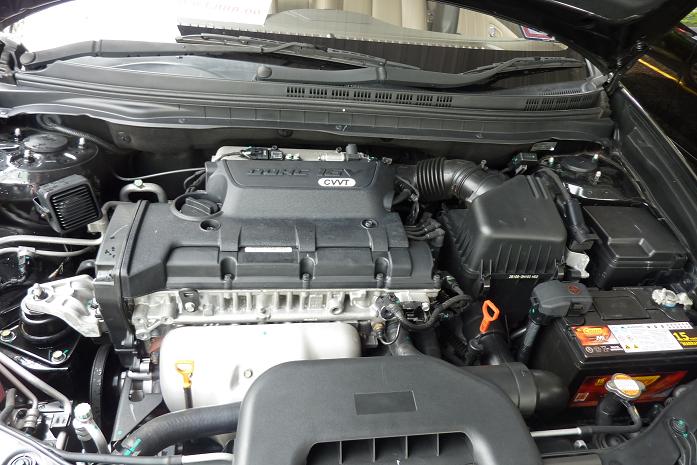
THE biggest single change in the CR-V is the increase from a 2.0-litre non-VTEC engine to a 2.4-litre i-VTEC engine. Apart from the increase in capacity, the difference is really the i-VTEC technology. Variable valve timing gives the engine a greater power and torque range as well as improved fuel economy and lower emissions. The i-VTEC engine employs two technologies: VTEC - a mechanism for switching cams between low and high-speed ranges; and VTC - a cam phase control system based on engine speed and load. The result is an engine that performs well under most situations. Around town there is plenty of torque available to move with the traffic, without the need to work the gears hard, and on the highway there is plenty of top-end power to overtake safely. The engine is quiet and revs freely to the higher end of the scale with no noticeable vibration.
Mechanical - Suspension
HONDA revised the fully independent suspension on the CR-V to introduce a new front and rear set up. Previously double wishbone all-round, the CR-V now has single wishbone with toe-control link MacPherson strut at the front and double wishbone with reactive link rear suspension. Both front and rear use stabiliser bars and Honda's progressive valve gas shock absorbers. The result is greater interior space through more compact design and a softer, quieter ride. But the suspension lacks the stiffness to hold the vehicle firmly when cornering at speed and body roll is noticeable to the point that it affects steering response.
Mechanical - Transmission

CR-V Sport is available in both auto and manual. The four-speed auto has a lock-up torque converter to provide greater highway fuel economy and Honda's Grade Logic Control - a system that automatically downshifts and holds a lower gear when climbing a steep grade. Honda has improved the shift quality of the five-speed manual to give it a more sporty, short throw feel but the gear knob is small and does not suit the larger proportions of the vehicle. Technical specifications have been upgraded with the use of triple or double cone synchronisers on all forward gears except fifth, which uses a single carbon-faced synchro. Fuel savings have been made by using less transmission oil to reduce losses caused by viscous friction.
Mechanical - Brakes
CR-V Sport is fitted with 282mm ventilated front disc brakes and 282mm non-vented rear disc brakes. An anti-lock braking system (ABS) comes standard on the Sport model but remains unavailable on the base CR-V grade. The Sport model also has electric brake force distribution (EBD), which optimises the front and rear brake pressure distribution to provide more efficient stopping power and greater vehicle stability.
Mechanical - Steering

THE CR-V has kept its high mounted power-assisted rack and pinion steering system. The turning circle has been reduced by 0.2 metres to 10.4 metres as a result of the change in front suspension. The turning circle compares well with other similar sized vehicles and requires 3.26 turns lock to lock. The amount of power assistance required is automatically controlled in accordance with the front wheels' resistance to steering force - increasing the steering assistance at low speed and reducing it at high speed. This helps maintain a positive steering feeling and straight-line stability.
Did you know?
Honda claims the new toe-control link MacPherson strut front suspension design delivers quick, responsive handling by helping maximise each front tyre's contact with the road throughout the range of suspension travel
Safety

HONDA claims its designers and engineers approached the body structure of the 2002 CR-V to provide "all-around protection". Engineers used computer-based stress analysis programs to add 50 per cent greater torsional rigidity and 30 per cent greater bending rigidity to the CR-V, resulting in improved ride, handling and safety. Honda's G-Force Control or G-Con technology enhances the vehicle's ability to absorb energy in a collision by the use of front and rear-end structures which help retain a crush-proof cabin for occupants. Twin front airbags remain and no additional airbags have been introduced with this model. Beneath the skin there are a number of items that improve the overall safety level such as fire retardant interior, fuel tank roll-over valve, progressive crumple zones, seatbelt pretensioners and side impact protection.
Rivals
1) Honda CR-V Sport 2) Toyota RAV4 Cruiser 3) Nissan X-Trail Ti
TRANSMISSION
1) four-speed auto 2) Five-speed manual or four-speed auto
3) Five-speed manual or four-speed auto
DRIVING WHEELS
1) Part-time four-wheel drive
2) Full-time four wheel drive
3) Switchable four-wheel drive
ENGINE
1) 2.354-litre front-mounted transverse 16-valve DOHC inline four-cylinder with variable valve timing
2) 1.998-litre front-mounted transverse 16-valve DOHC inline four-cylinder with variable valve timing
3) 2.488-litre front-mounted transverse 16-valve DOHC inline four-cylinder with variable valve timing
MAX POWER
1) 118kW 2) 110kW 3) 132kW
LENGTH
1) 4555mm 2) 4195mm 3) 4510mm
WIDTH
1) 1780mm 2) 1735mm 3) 1765mm
HEIGHT
1) 1710mm 2) 1680mm 3) 1675mm
WEIGHT
1) 1500kg 2) 1328kg 3) 1440kg
DETAILED SPECIFICATIONS (Malaysian spec): -updated Saturday (18/10). Source:(c)
Engine: 4 cylinders-in-line DOHC, I-VTEC 16v 1998cc, Honda PGM-FI fuel injection and engine management system. Light alloy block and head.
Bore/stroke: 86x86mm, Compression Ratio: 9.8:1.
Max Power: 115kw@6500rpm. Torque: 190Nm@4000rpm.
Transmission: Variable All-wheel-drive. Electronic controlled 4 speed automatic. Gear ratios:
1st) 2.684
2nd) 1.534
3rd) 1.081
4th) 0.695
Rev: 2.000
Final: 4.582
Suspension:
Front: Independent, MacPherson struts with coil springs and dampers.
Rear: independent trailing arms, double wishbones, coil springs and dampers, reactive link with anti-roll bar.
Steering: Rack and pinion, servo assisted. Lock to lock turn: 3.2. Turning circle: 10.4m
Brakes:
CR-V is fitted with 282mm ventilated front disc brakes and 282mm non-vented rear disc brakes. An anti-lock braking system (ABS) comes standard. So do the electric brake force distribution (EBD), which optimises the front and rear brake pressure distribution to provide more efficient stopping power and greater vehicle stability.
Other specification:
FUEL TANK: 50L
Ground clearence: 205mm
Performance:
Maximum speed: 190km/h.
0-100km/h 12 seconds (as tested by "Auto International" (Malaysian) Car Magazine)
END OF SPECIFICATION. Again, source: (c)
END OF A LONG REVIEW, THANK YOU for having the patience to read it…
REFERENCES:Source a) http://www.goauto.com.au/mellor/mellor.nsf/story2/CFC9AB1697C0F7DACA256B7D0001E10D. GoAuto Supertest by Steven Butcher
Source c) Auto International (Malaysian Car Magazine) Buyer’s Guide 2003. For Specifications of the CRV.