Google Search

Google

Sunday, October 22, 2006

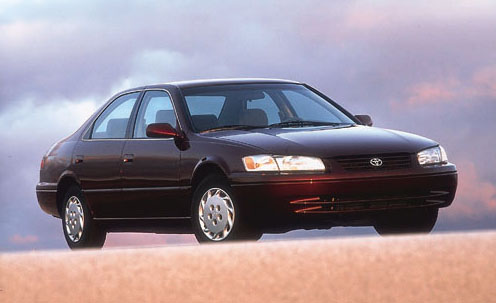
FULL REVIEW: 1998 Toyota Camry 3.0i V6 24v Quad-Cam

In this blog, I am reviewing 1998 Toyota Camry 3.0i V6. It’s imported from Australia and sold in limited numbers in Malaysia. Due to the prohibitive road tax and High Fuel Consumption fear, Camry 3.0i V6 is a Rare model as 9/10 Camry sold in Malaysia were 4 cyl 2.2i model. Here’s the summarized article 2/3 is taken from a defunct Malaysian car magazine, Highway Malaysia, January 1998 issue.

Continuing on the theme of international styling and image, the new Camry is distinctive but not radical (ie. Won’t turn heads). The designer spent a great deal of time in the wind tunnel shaping the Camry to be as aerodynamic as possible. The outcome? A 0.30Cd of Co-efficient of drag. All surfaces, including the door handles have been kept as flush as possible and the corners rounded off. The front bumper is contoured to smoothly direct airflow around and above the car and airflow around the whole body is smooth and there are no protrusions to cause turbulence. The front and rear windscreens are bonded to the bodyshell, reducing the gap to just a few millimeters, while the side window glass is positioned as flush as possible which contributed to the low Co-efficient of drag.

The new Camry is a larger car than before, but somehow the new styling cleverly disguise the bulk. The wheelbase is now 2670mm, a generous increase OF 5mm which resulted the length extended to 4755mm, 30mm longer than before. The width is now 12mm more than its predecessor, while the overall height is now 9mm higher.

INTERIOR:

Due to the exterior dimensions increase, the interior space also increased and the level of luxury fittings improved significantly. There’s wood grain trim laced around the dashboard with supple leather upholstery. Both front seats are electronically adjustable with driver side having 6-way adjustable.


The odometer and tripmeter display are now in digital form. The Camry comes with many convenient features such as power windows with anti-jam mechanism, central locking with COBRA Alarm and Immobilizer. Also, it has additional 12v outlets. It has plenty of storage space with lockable glovebox, front door pockets, centre console box which doubles as armrest AND two Cupholders with dedicated lid. Rear passengers has great leg/head and shoulder rooms with space for 3 full size adults or 4 (YES 4!!!) childrens each with rear seatbelts and headrests
For the In-car entertainment, it came with Kenwood AM/FM Cassette with RDS and 10 disc CD-Changer at the boot with steering wheel remote control with controls the volume, station and tracks without taking the hands off the steering wheel.


SAFETY:

The new Camry lays claim to being the safest Camry yet, exceeding all current and foreseeable crash test criteria for North America, Europe and Asian countries. Interestingly, it is 6 years ahead of tough Australian Design Rules of passive safety. All these were achieved with the help of Toyota’s in House GOA (Global Outstanding Assessment). GOA is claimed to be one of the strictest crash test criteria standards in the industry. For example, in frontal collision tests, the accepted European standard is 56km/h, but Toyota designed it for a higher impact speed of 65km/h.

The New Camry is the First Locally assembled Japanese car to have two front airbags as standard. The airbag system makes use of electronic sensors for fool-proof operation. The sensor is designed to determine the severity of the front collision and inflate the airbag(s) if exceeds 25km/h within milliseconds.

The brakes is equipped with 4 disc brakes system with front being ventilated. It has standard electronic 3 channel/4 sensor ABS.


ENGINE/TRANSMISSION

The heart of the new Camry V6 is not the same as the one in the previous generation (which is imported and sold in a small number in Malaysia). A major difference is that the engine is “ALL-Aluminium” and 40kgs lighter. It is said to share many of the same materials and design architecture as the Lexus LS400.

The timing of the 24 valves has been carefully set to ensure strong curve in the lower end of the speed range for responsiveness. The V6 engine delivers 134KW of DIN Power (183hp) at 5200rpm and 267Nm of torque at 4400rpm. It has 3 way catalytic converter and meets the current emission control standards set by the Malaysian Government.

Only a 4 speed Automatic transmission with Electronic controls is available. The new transmission has “intelligence” and is so clever that it does away with the previous “POWER/ECONOMY” Switch. An extra feature of the gearbox is a lock-up clutch which eliminates slip-induced power loss. Cruise control is a standard feature. For practical reasons, in automatically disengages whenever the brake pedal is depressed. It also won’t activate at speed below 40km/h.

The Camry has 4 independent suspensions with front being :McPherson Struts and coil springs, lower arms with stabilizer bar in a sub-frame mounting. The lower control arms of the front McPherson struts are forged in 1 piece for less weight and greater rigidity. For the rear, a dual link arrangement is used with McPherson struts and coil springs. It also has anti-roll bar in a sub-frame mounting (like the front).


My EXPERIENCE: BUT AND A BIG BUT. The suspension setting is SOFT, and tuned for comfort only. “Whacking corners” is strongly discouraged in this car as it will understeer easily and/or cause discomfort to passengers. If you loved to drive fast on corners or ZIGZAGGING between lanes, this car is not for you UNLESS you upgrade to harder springs/shocks. Instead, it is at home at Highways, driving at a cruising speed or high speed. In fact, 180km/h feels like 110km/h. Super quiet, super stable. It is designed for American roads (As it’s the best-selling car in America from 1998 to 2001) which consist mostly LONG, STRAIGHT roads. Ride comfort is FIRST CLASS akin to it’s sister car, the LEXUS ES300.

The rack and pinion power steering is perfectly weighted which gives the driver a good control feedback of the car… The smoothness was really amazing and the car is PHREAKING QUIET! Engine barely audible at idle and the noise only came alive after revving past 5000rpm!!! Top speed is electronically limited to 210km/h as it’s build in Australia, hence Aussie specs. A sensible guess is 225km/h without the limiter.


FINAL SAY: The Camry 3.0i V6 is freaking RARE in Malaysia. Like I said earlier, only 10 out of 100 (or 1/10) Camrys’ sold in Malaysia are 3.0i V6 Quad-cam 24v model. The Camry is SO good that it’s American Best selling car for 3 yrs in a row beating the Accord and the Ford Taurus. Being No.1 in a HIGHLY Competitive market is NOT EASY! A check in MSN Car Owner’s review shows an averaged 8.7/10 points rating with 3 / 4 of them giving 8 /10 ratings and above and half of them keeping the car (mostly 1999) for another 5 years (up to 2010!) or would buy another CAMRY! SELECTED COMMENTS:

1) “Bought this car brand new from the dealer back in 02/1999. Owned it for 7 years now and has 105K miles on it. The only maintainance that I did was oil change, breaks after 80,000 miles, and tires and wipers of course. I sat down and I calculated how much this car cost me in maintaiance so far including oil changes and tires, It came up to $1900 in seven years. Very realiable and smooth until now. I am keeping this car until it stops although I am doubtful that this will ever happen. I am planning to get 300K miles out of it.” (OVERALL RATING: 9 / 10)

2) “If you want the most dependable car in the world, this may be your best choice unless you tend to get bored easily due to the lack of certain excitements.” (OVERALL RATING: 9.6 /10)

3) This is an excellent vehicle. I purchased this car new 6 yrs ago, and have had no problems with it. Currently it has more than 250K miles, and still starts up, and drives like the day I bought it. My father in-law says it drives and runs better then his 2002 Honda Accord. Even the leather and all other interior materials have held up. Over all this has been an excellent vehicle and I hope to put on another 150K miles before I sell it. (OVERALL RATING: 10 /10)

4) Having owned this car for about six years, I can say that reliability is one of its greatest assets. It is a beautiful car with a silky smooth powertrain and a terrific ride! Seating comfort is another big plus, and even the rear seats are surprisingly comfortable on long trips. Overall, a luxury car without the ridiculous price tag! This is definitely the best car I've owned! (OVERALL RATING: 10 / 10)

5) Great power from the V6, excellent 4 speed AT, typical Toyota, everything works as advertised. reasonable gas mileage at 25mpg. Have used for nearly 4 years and 57K miles. (OVERALL RATING: 9.7 / 10)


BRIEF SPECIFICATIONS:

Engine: FWD. V6 2995cc, Quad-Cam 24valves EFI. All aluminium cylinder head and block with bore/ stroke of 87.5/83mm and compression ratio 10.5:1

Max Power: 134kw DIN (183hp) @ 5200rpm
Max Torque: 267Nm@4400rpm

Gearbox: 4 speed Electronic auto transmission with torque converter and intelligent programming.

Front suspension: Independent McPherson struts and coil-springs, lower arms, stabilizer bar with sub-frame mounting. Rear suspension: McPherson. Dual link, damper, struts and coil springs, anti-roll barwith sub-frame mounting.

Wheels/tyres: 15” alloy/205/65R15
Brakes: Ventilated discs/drums with 4 channels and sensor ABS.
Dimensions:
Length: 4760mm, Width: 1785mm, Height: 1420mm, Wheelbase: 2670mm.
Front and rear track: 1545mm and 1520mm
Ground clearance: 145mm. Weight: 1300kgs
Fuel tank cap: 70L

Performance:
Top Speed: 210km/h, electrically limited (Australian regulations)
0-100km/h: 8.6 secs. (Tested)

PRICE and NOTE: RM165,000 NEW back in 1998. Today: RM58,000 average (or lower) for 1998 V6 3.0i 24v model. Freaking RARE in Malaysia. Often bought as Company car(s) as typical Malaysians are turned off by the high road tax (RM1300 est. P.A.), high fuel consumption perception (due to 3.0 V6). Think of it as Budget Lexus ES300 (Same Engine, Suspensions, Gearbox and Refinement but different Exterior and interior styling). Grab it if you found one. 100% Worth the money!

Standard Equipments:

Air Conditioning with Climate controlCruise Control

Elec Adj front seats (6 way driver seats) with lumbar support
Leather seats

Locks, Power Door withCOBRA Anti-theft systemCup Holders2x 12v Sockets (One lighter, one accessories)

Steering Wheel, 4 way adjustableWindows, Power (4x) with one touch driver Air Bags, Driver and Passenger SideChild Safety Seat AnchorsLocks, Child Safety

Rear 3 point seatbelts Kenwood, AM/FM with Cassette + 10 disc CD-Changer

“Secret Box” compartment (see picture above). Power steering5 pieces Alloy wheels with 205/65VR15 tyres

Woodgrain trim panels around the dashboard.

APPENDIX (23/10): This generation of Camry is sold in Malaysia between 1998 to early 2002. The estimated sales figures as follows: 2.2i: 14,000 units +/- (Averaged 280 units sold per month). The 3.0i is on sale from 1998 to 2000 only. During the facelift in 2000, the 3.0i model is dropped. Toyota imported about 600 units of the Camry 3.0i from Australia between 1998 to 2000. This means that around 95% of the Camry sold in Malaysia were of 2.2i model. Like I say, If you see a good used 3.0i V6 Camry on sale, GRAB IT!!!

Monday, October 09, 2006

To New car dealers. Trade in price of old car matters...

In order to secure sales... Lowish trade in value often turned potential buyer off. Let me relate 2 case studies involving Hondas.

The first case study involved Honda and Toyota. Ever wonder why The New Vios outsold the City by 2:1 every month? Besides more aggressive marketing campaign (TV, Radio), sponsoring cars for Shell Fuel Economy Challenge, the MOST IMPORTANT reason is LOW Trade in of old cars for their new cars.

Case example, my Auntie was interested in fuel economical Compact family car. She wanted to trade in her Black 1999 Perdana V6 for a new car. She shortlisted her choice to City VTEC and Vios 1.5G as both within her budget. She prefer the more spacious City VTEC and wanted to buy, BUT and a BIG BUT, The Dealer offered RM32,000 only for her Perdana V6. She felt shocked over the LOW LOW trade in value. Next stop, UMW Toyota Showroom in Sec 19, P.J., The salesman in Toyota is Not only friendly but offered RM2000 Merdeka discount AND WAY HIGHER trade in value too. The dealer offered RM39,000 trade in price for her Perdana V6. To cut the story short, she ended up booking the Vios.

Case study 2: Ford and Honda. My friend is keen on buying a Compact SUV to replace his ageing 9 years old Toyota RAV4. He narrowed his choices to Ford Escape 2.3i and Honda CRV 2.0i. He visited both Ford and Honda Showrooms and test driven and compared both cars. The Escape wins on specifications (Leather, Large sunroof, electronic seats adjust, Bodykits, more powerful 2.3i engine from Mazda 6), and Price. His mind goes for the Ford, But being a fan of Honda, his heart goes for the CRV.

The problem is that Honda dealer don't know how to secure sales. Offered RM45,000 trade in price for the RAV4 with no discount (but offered 2 yrs free maintenence and V-Kool). In the end, he chose Ford. Why? Cash discount (He had chosen that over 0% Interest rates), 3 yrs warranty, RM55,000 trade in value for the RAV4. (that's 10,000 less + estimated RM8000 cash discount = RM18,000 less than CRV.

So Honda and other new car dealerships, the ball is on your side, buckle up and do something about your Trade in price of old cars before you lose your sales to your rivals... AND the the attitude (eg. friendly, prompt, helpful) of Sales Representative(s), Oh! And the financing as well especially the Interest rates and monthly repayments.

Tuesday, September 12, 2006

SPECIFICATIONS: PROTON PUTRA and WIRA 1.8I DOHC (in bracket)

DETAILED SPECIFICATIONS: PROTON PUTRA and WIRA 1.8EXI DOHC (in bracket)


1) Engine:

4 cyl in-line 1834cc DOHC 16v ECI-MULTI fuel injection
Bore & stroke: 81x89mm, Compression ratio: 10.5:1
Cast iron block and light alloy head (Wira all same)


2) Power:

Max power/torque: 140hp@6500rpm/167Nm@5500rpm (Wira same)


3) Drivetrain:
Front wheel drive, 5 speed manual/4 speed automatic with Overdrive mode
(Wira 1.8 DOHC – 5 speed manual only (initially in first 2 batches). 4 speed auto – option offered in 3rd batch from 1999-2000)

Manual:
1st: 3.083
2nd: 1.950
3rd: 1.285
4th: 0.940
5th: 0.777
Rev: 3.080
Final drive: 4.320

(Wira same)

Automatic:
1st: 2.846
2nd: 1.581
3rd: 1.000
4th: 0.685
Rev: 2.176
Final drive: 4.007 (Wira same)


4) Dimension (mm) and weights (kg): (Wira in bracket)
Length: 4230 (4360)
Width: 1690 (same)
Height: 1365 (1385)
Wheelbase: 2440 (2500)
Fr Track: 1450 (same)
Rr Track: 1460 (same)
1055kg (1100kg)
Turning circle: 10.2m (same)


5) Body/Chassis:

Suspension: Front: Integral MacPherson struts, anti-roll bar. Springs (Duh!)
Rear: Multi-link, anti-roll bar. Springs and dampers (Duh!)

Brakes: Front: ventilated discs, rear discs, 4 channel/sensor ABS

Steering: Usual rack & pinion power-assisted

Wheels/tyres: 6J x 14 Alloy by AAC, 185/60R14
(Wira 1.8 DOHC: Body/Chassis all same as Putra)


Fuel consumption (FC):
Fuel tank capacity 50Litres. Average FC: 8 kms/litre. (Wira 1.8 should be the same)


Performance:

Top speed: 205km/h (Claimed) Manual, 190km/h Auto (Wira DOHC: 210km/h - claimed)
0-100km/h:
Man: 7.6 secs (tested - LOCAL Car mag) [(Wira DOHC: 8.3 secs - claimed)]
Auto: 9.7 secs (tested - by me)
Rpm@100km/h: 2700rpm (5th gear, manual - tested by a Local Car mag)

PRICE:

New 2000: RM69,000 – Man; RM72,000 Auto .
(Wira 1.8 DOHC PERT Edition: Man: 69,000, 73,000Auto)

Today’s averaged price: RM36,000 for year 2000 manual, extra RM2k for Auto model. For Wira 1.8 DOHC PERT Edition (M) year 00’ model: RM35,000.

Brief review: Proton Putra

Back in 1996, Proton is on a roll having captured almost 70% of the sedan and hatchback markets. To keep this leading position, Proton is looking to enhance its vehicle sales further by entering niche markets. Proton had identified the market and it’s affordable sports coupe where the potential buyers were young hot blooded “boy racers”. The segment was once ruled by Ford Laser TX3 till the mid 90s. The car was officially introduced as Proton Putra. It is a 2 door version of the Mitsubishi Lancer.


Dimensionally, the overall length of the Putra (4230mm) falls between Wira Sedan and Satria, but it has closer relationship to the Satria by having the identical wheelbase of 2440mm and is shorter by 60mm than the sedan and aeroback.

Underneath the Putra is what makes it so special. The engine is identical to the Wira 1.8EXI DOHC a 1834cc DOHC unit which produces 140hp@6500rpm and 164Nm of torque at 5500rpm.

For stopping power, there are disc brakes all round with the front being ventilated. Factory fitted ABS with 4 channel 4 sensor. Alloy rims are standard with 185/60R14 tyres.


The Putra had the same dashboard as the Wira, but it came with cupholder, Momo steering and titanium effect “sticker” on the dashboard (see picture). The dash meters are the same as Wira 1.6i but with the speedometer right up to 260km/h and tachometer redlines at 7000rpm!


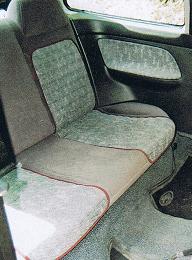
It also came with Recaro seats. The door being a coupe is wide and access to the rear is easy. Like most 2 door cars, the seatbelt anchor positioned too far back from the front seats and requires turning your back to reach the seatbelt. The seats being Recaros were supportive in the right area, not to firm, not too soft. The rear seat space is only comfortable for 2 (see picture) as the “transmission hump” renders the legroom useless for the “rear middle passanger”.


That’s all I can report. As I did not have the chance to drive the Putra as the car dealer won’t allow (I saw this Putra, totally stock year 2000 model Automatic priced at RM37,000). I am just a passenger in the car, the dealer just gave me a test ride in the car! The only thing I can comment is it’s a high-revving car with reasonable ride and handling (the car has stock 14” AAC rims with 185/60R14) with limited body roll thanks to the standard Recaro. Pickup is decent for an Automatic, 0-100km/h around 9.7 seconds.


To conduct a fair review, I"M PLEASE TO INVITE 2x PUTRA OWNERS TO WRITE A REVIEW HERE AS SOON AS POSSIBLE!!! I'D ALSO INVITE 2x OWNERS OF WIRA 1.8 EXI DOHC OWNERS TO WRITE A REVIEW. The following blog are the Specifications for both Putra and Wira 1.8EXI DOHC. Both are almost the same car, have the same engine, chassis, dashboard and near-identical performance. The differences are in dimensions and body style only.

Saturday, September 09, 2006

The Concept of this blog...

The purpose of this blog is reviewing used cars with specifications. The concept is it is going to be the interactive way!

I will kick start the review by giving my own impressions of a car and if I can’t give review, I’ll just upload the specifications and I want YOU!!! Visitors of this blog especially car owner(s) of the subject car to review the car by sending me the e-mail of your review and I will upload it… Don’t worry; I will acknowledge your work. But I will only post the 1st two reviews for non-national cars and 1st 4 reviews for National-cars in my blog…

EMAIL ME YOUR REVIEWS AT: otoreview@gmail.com


Oh! For Amateur Car reviewers only as the purpose of this blog is also showcasing the talents of amateurs only. Professional car magazine journalist(s) review(s) is/are discouraged.

I am also accepting “R.O.D” = Review on Demand. Ie. YOU!!! Visitors request a car for review (eg. Honda CRV) or the specifications and I will review it. Again, if I can’t review I will just give the specifications and invite the “owner” of the “requested car(s)” to review…


I also invite reviewers of used cars from our neighbouring countries, Indonesia and Singapore. But this time I won’t start the review or post the specifications, YOU ARE ON YOUR OWN. You are free to post your reviews on any car + the specifications as well. Again, by sending e-mail of your review to me and I will blog it and acknowledge your work…

The format of the review is up to you, 7 page maximum (as seen in Ms Word). But must include elements on:

i) Interior/Exterior

ii) Drivability@ On the road (include ride and handling, performance

iii) Ownership experience/proposition (eg. Maintenance, memorable experience with the car, what you add to your car++, AND would you recommend this car to other people?

iv) Fuel consumption (in mpg or Km/litre)

v) Pictures are limited to 2 interior, 2 exterior and 1 engine.

NOTE: ++ => Please don’t give me the details of what you modify to your car. This is a used car review blog NOT a car tuning or modification blog. Just a summary of:

i) Essential areas such as engine + gearbox (eg. From Mitsubishi 4G15 1.5 to 4G93 1.8 turbo, port and polished, 1 bar boost, auto to manual, LSD etc).

ii) Ride and handling enhancements (eg. suspension, rims & tyres)

iii) Brakes (eg. Cross drilled, rear drums to discs).


If possible DON'T need to cover "NON-essential" enhancements (such as In Car Entertainment (ICE), snake skin leather), or visual enhancements such as Bodykit/Paintworks (including Airbrush, 3k paint), etc… UNLESS YOUR CAR IS 100% STOCK w/o modifications and nothing to say in "ESSENTIAL" areas.

Monday, September 04, 2006

Review: Honda NSX (Acura NSX in US,Canada and Hong Kong)

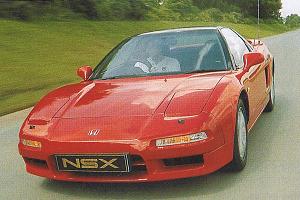
The Honda NSX is probably Japan’s first and only world class supercar to date. It was Honda’s first attempt at the exotic-car segment characterized by low-slung 2-seaters, often mid engined and ultra-fast with the rarity and price-tag to match.

Starting on a clean sheet of paper, Honda dug deep into its Formula-one racing experience and utilize its talents of the best think-tanks to develop what they would have us to believe is the true blue supercar. The great Ayrton Senna is involved in fine-tuning the car which probably explained why the NSX were still on the market for 15 long years. Heard this car is produced in memorium of the late Ayrton Senna. If Ayrton had been alive I think we would by right offered the 3rd generation NSX since a typical Japanese model change is 5 years old.

The NSX rook over 6 years and unlimited budget to develop. The NSX were developed to rub-shoulders with Ferrari and Porsche. To maintain its exclusivity, only 25 units were hand-built at Honda Tochigi plant each day. The NSX looks 100% like supercar but without the limited visibility and the temperament. It was comfortable at home in highways as well as for town use. It is used as an everyday car by Gordon Murray, McLaren F1 designer

(The following paragraphs were sourced from the now defunct “Highway Malaysia, August 1994” issue by Lionel Seah).

Honda created history by being the first mass producer to extensively use aluminium monocoque body

Aluminium not only resist rust but it is extremely light as well. In fact the whole body shell weights only 210kgs. Even the double-wishbone suspension sub-frames are forged in Aluminium. The result? The NSX weights 1370kgs only. These figures may be common in Honda Accord but it’s definitely lightweight by supercar standards. In 1994, Honda produced an even more lightweight version called “NSX-R” as an answer to Porsche Carrera RS.

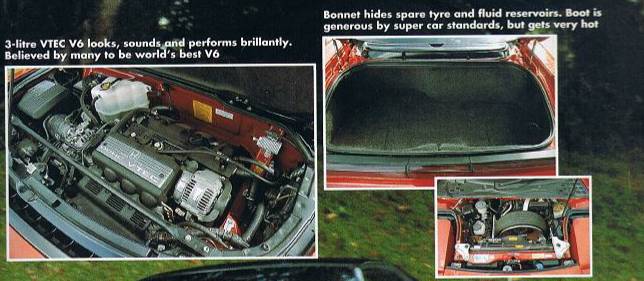
The engine consists of a compact DOHC V6 3.0 24V engine with Honda’s own VTEC (Variable valve timing and lift electronic control). The results?

It achieved a maximum power of 274hp @ 7300rpm and a torque of 284Nm@5400rpm for the manual and 256hp@6800rpm for the automatic, the maximum torque for the Automatic gearbox is the same as the manual.

(All pictures Source: Motoring Singapore August 1994 issue)

The power delivery of the car is wonderfully smooth and linear, the 0-100km/h is 5.2seconds for manual and 5.7 seconds for Automatic.

By supercar standards, the NSX is a quiet car, at cruising speeds the engine note is barely an audible whirr. The wind noise is well checked even at high speeds. To bring out the glorious addictive sounding noise, just rev the tacho needle towards the redline (at 7300rpm for the manual).

The interior:

The environment befits that of an exotic car as you sit close to the ground, almost straight legged in wonderfully supportive all leather seats. The wonderful thing about the NSX is that there’s no claustrophobia that is typical in supercars. The cabin is plain (see picture), it looks at home in a Honda Legend. Thanks to good outward visibility (compared to other supercars) and generous shoulder room, the driving environment is ideal and with extra space to stretch.

Although there is very little storage compartments, the “boot” behind the engine (the NSX was a mid-engined remember?) car at the rear is enough for a pair of golf bags.

The European car critics may label the NSX as sterile and lacking in character but no one can deny that it is immensely user-friendly and so easy to live with even as an everyday car. It still has the necessary head-turning ability to qualify as a world-class supercar. It is a very civilized yet addictive car (when the VTEC screams at redline).

BRIEF SPECIFICATIONS: HONDA NSX (other than gear ratios, specifications is sourced from “Highway Malaysia, August 1994” issue)

Engine:

Mid-engined V6 DOHC 24V 2977cc EFI with VTEC

Compression ratio: 10:2:1, Aluminium Cylinder head and block

Power:

Max power: 274hp@7300rpm (256hp @ 6800rpm – auto)

Max torque: 284Nm@5400rpm (auto and manual same)

Drivetrain: Rear wheel drive, 5 speed manual (Ratios –NA-) or 4 speed auto.

Ratios for 4 speed auto (source Motoring Aug 94 issue):

1st: 2.611

2nd 1.466

3rd: 1.025

4th: 0.777

Final drive: 4.066

Dimensions and weight:

Length: 4430mm

Width: 1810mm

Height: 1175mm

Wheelbase: 2530mm
Fr track: 1510mm

Rr track 1530mm

Ground clearance: 135mm

Kerb weight: 1370kgs (1410kgs – auto)

Turning circle: 11.6m

Performance:

Top speed: 274km/h (270km/h – auto)

Acceleration 0-100km/h: 5.2 seconds, 5.7 secs - auto)

Fuel consumption:

Fuel tank capacity: 70litres

8.9kms/litre

RPM@100km/h in OD: 2700rpm.

(end of source)

Note that Honda produced a very limited number of NSX type R in 1992 for Japanese markets. Major changes include a more aggressive suspension and an extensive weight reduction to 1230 kg from the normal NSX weight of 1370 kg. The NSX type R was very track oriented as it lacked sound deadening, audio, electric windows, and air conditioning in an effort to reduce weight. A second iteration of the type-R dubbed NSX-R was released in 2002 again exclusively in Japan. The NSX-R has a more aggressive rear spoiler and hood vent, along with various refinements to reduce weight to 1270 kg. Also it came with HiDs and etc...

Update: From 1997 onwards, Honda NSX came with a facelift and a new engine: 290hp V6 3.2 VTEC and 304Nm of torque with 6 speed manual (extra gear ratio). But the Auto is still using 3.0V6 VTEC. In 2002, Honda introduced, NSX Type-R, but restricted for sale in Japan only. Production ended in 2005 after 15 years of manufacturing.


Okay, I’m tempted! How much is a used NSX in Malaysian market today if there’s one on sale?

Being a “supercar”, the NSX is still exclusive and far from reach to the general Malaysian. It is still priced between 168k and 190k for a 1991 model today (averaged 180,000) depends on condition and the urgent-ness to sell the car. It is too pricey and at 15 years old is almost impossible to obtain car loan… Perspective buyer is typically rich and often will pay Cash for it…

Newer models add about 10% each year. Eleven years old is the oldest year to obtain hire purchase (loans) at low interest rates, the price will be around RM270,000 for a 1995 model.

Note that a brand new Imported NSX costs a whooping: RM1,107,485 OTR. Officially imported by Kah Motors back in 1994.


Saturday, September 02, 2006

Peugeot 406ST Specifications (& review)

To ensure fairness or accuracy of the review on Peugeot 406, I will invite TWO 406 owners to review on their car (especially member(s) of the Peugeot Owners Club Malaysia). You just have to e-mailed me your work (suggested layout: Looks, Interior, Drivability, Ownership proposition - eg. experience owning it) and I will post it here. Oh! Also, 1 picture of the car exterior and engine bay. Don’t worry, I’ll acknowledge your work. Since I’m not an owner, I have no position to review the 406. However, I will share the Specifications of Peugeot 406.

SPECIFICATIONS:


Engine: Front engined, I4 1998cc DOHC 16 valve Electronic multi-point fuel injection

Bore/stroke and compression ratio: 86 x 86 and 10:4:1

Driving wheel: Front

Max power/torque: 135hp @5500rpm / 180Nm@4200rpm

Gearbox: 4 speed electronic auto adaptive Automatic OR 5 speed manual (Ratios –NA-)

Ratios:

1st – 3.327

2nd – 1.813

3rd – 1.224

4th - 0.881

Rev: 3.147

Final drive: 3.450

Chassis:

Front suspension:

Independent, McPherson struts and coil springs, lower wishbones, telescopic dampers and anti-roll bar.

Rear suspension:

Independent multi-arm location, trailing links, telescopic dampers and coil springs, anti-roll bar. Passive rear wheel steering.

Steering: Rack and pinion, speed sensitive power steering

Wheels/tyres: 6jx15 alloy rims with 195/65VR15 tyres

Brakes: Front: Ventilated Discs, Rear: Discs. 4 channel (front and rear) ABS.

(THE FOLLOWING IS SOURCED FROM “Highway Malaysia, April 97’ issue)

Vital statistics:

Length: 4555mm

Width: 1765mm

Height: 1396mm

Wheelbase: 2700mm

Front track: 1500mm

Rear track: 1482mm

Weight: 1355kgs

Turning circle 11.4m

Fuel tank capacity: 70 litres

Performance:

Top speed: 197km/h

O-100km/h: 12.88secs tested.

50-80km/h (kickdown): 5.6 seconds

RPM at 100km/h in OD: 2400rpm

Fuel consumption:

Urban: 9.3kms per litre (26mpg)

Highway: 15kms per litre (42mpg)


PRICE: RM121,000
for Deluxe model back in 1998.

(end of source)

TODAY, A 1998 model is yours for around RM30,000 only...

Features: Climate Control, Airbag (later model has dual airbags), rain sensor, 60/40 split rear seats, rear sunshade. Cruise control, optional leather seats (year 2000 model onwards came standard), Auto adaptive intelligent 4 speed Automatic gearbox (or 5 speed manual), Lockable glovebox, 4 channel, 4 sensor ABS etc, V-kool (standard)…

Thursday, August 24, 2006

“NEW” Used Telstar, end of 1st year owner’s report. + V6 model too!

On 8/8/2005 my dad bought a used 1999 Ford Telstar 4 cyl 2.0i Auto meant for himself, but he is based in Hong Kong, so I am the one driving the car. (Co-incidentally, on the same date in 1990, my dad also a bought Ford, the Laser TX3 featured earlier). Back to the Telstar, the car came with V-Kool tinting and Standard Semi-Bucket front seats with luxurious Ghia trimmings AND Nice no plate “WG_ 1222”. It is a Clone of Mazda 626. It is assembled in Malaysia (CKD- Completely knocked down with Jigs from Australia). This means that the car is “Half Japanese, Half Australian and born in Malaysia. Strangely, this car has oscillating center air vents and climate control with “Heater” which is absurd and useless in Malaysia.

Well, it’s been a year since “I” owned the car. Believe it or not, I only covered 6,000kms during the period of 1 year which means averaged of 500kms per month only. It was 93,600kms when It reached my garage. Now the odometer reads 99960kms (about 63000 miles). Pretty low mileage for a 7 years old car… Why so little mileage?


Because I have my own car, A UK-spec Proton 1.5 MPI (A) (3 speed Auto, Sux eh?) so the Telstar is driven 2-3 times a week only.

How is the running costs?

The car fuel consumption (FC) varies. Full tank (60Litres) lasted about 280kms only city driving but goes as far as 450kms on highways.


The Telstar is quite reliable. There’s only 3 problems during the entire 1 year owning the car. First, the Fuel tank leaked – discovered on the 1st week owning the car. Took 3 days and 6 chop shops (junkyards) finding the right fuel tank (from Mazda 626). Paid RM600 for the fuel tank.

Second problem which I haven’t fix since the car was bought. It’s the Engine mounting. The costs of replacing the engine mountings were expensive (RM1600 (USD450) for 1 set). The effects? The car vibrates when idle in “D” mode. Putting it in “N” mode solved the problem.

Recently, the front right headlight not working. Contemplating whether or not want to change to HiD (Xenon).

How is the ride and handling and performance of the car?


Pioneered by Ford (1st seen in Escort) the Telstar suspensions consists of Front and rear McPhersons and front and rear anti-roll bars, Lower “A” arms front and trapezoidal multi-link at the rear! All round dampers and springs (duh!). Thanks to the hi-tech suspension, it can soaked up any bumps and/or potholes surfaced. There is little nose-diving at hard braking and also little body roll at high speed cornering, I think the semi-bucket seats also helped. Imagine what it can do when it’s fitted with 215/45R17 tyres. I just can’t wait…

The car is very stable even with 195/65R15 tyres. It is not only stable but quiet at high speed with almost non-existence wind noise, I reached 160km/h without me and my friends realizing during a trip to Port Dickson back in early July. It’s like doing 110km/h, very stable. As a comparison, my main car Proton Iswara 1.5MPI(A) whole car floats and unbearable wind noise came in above 120km/h. Ie. Whenever I do 120km/h, my friend will noticed and say
that I’m speeding (the Malaysian speed limit is 110km/h).


Anyway, back to the Telstar, How is the performance? The acceleration is quite brisk, 0-100 in slightly below 12 seconds. 50 to 80km/h overtaking is 5.7 seconds. The top speed I don’t need to test, found out from a car magazine, that it reaches 200km/h at slightly below 6000rpm.

To complement the advanced suspension, the car has 4 discs brakes and ABS. I haven’t really tested the brakes. But emergency braking is quite effective with no brake locking (got ABS mah! - Duh!) and minimal nose-dive (co-operation with suspension?). So the suspensions and brakes department is well checked.

I was not-so happy having difficulty finding out the specifications of the car. Not many information available in the Internet it till today. But I found a brochure of Ford Telstar when I spring-cleaned my room. Apparently, my dad checked out the Telstar at the launch back in 1992 and brought home a brochure which has all the necessary details of the car… You have to thank me for blogging it here to all of you…

SPECIFICATIONS: FORD TELSTAR 2.0I4 16V (2.0I v6 QOHC 24V)

Engine:

In line 4, DOHC 16v 1991cc EFI and VRIS system (Variable rate Induction System – I don’t understand how it works, anyone can help?)
Bore and stroke: 83x92mm, Compression ratio: 9:1

(v6 1991CC QOHC 24v EFI and VRIS system

Bore stroke: NA, compression ratio: 9:1

Maximum power: mailto:130hp@6000rpm,

(v6: 147hp@6300rpm)

Torque: 170nm@4600rpm (V6: 179nm@5000rpm)

Transmissions: 4 speed auto. Gear ratios:

1st 2800

2nd 1540

3rd 1000

4th 0700

Rev 2333

Final ratio: 4.157


Suspensions: See review above (in bold)

Steering: Rack and pinion speed sensitive variable power steering, height adjustable.

Brakes: Front ventilated discs, rear discs, servo assisted, 4 channel ABS

Dimensions: (all milimetres)

Length: 4670

Width: 1670

Hight: 1400

Wheelbase: 2610

Front track: 1500

Rear track: 1500

Weight: 1145kg

Wheels: 195/65R14 steel rims. Alloy rims for V6 model.

Fuel consumption:

FC: 6.5km/litres combined.

Fuel tank Capacity: 60Litres


Performance:

See review above for 2.0 4 cyl model.

(for V6 model: Top speed: 212km/h, 0-100km/h: 10.4 secs.)

Other features: Oscillating centre air-vents, intermittent wipers, 2 concealed front cupholders, 60:40 split rear seatback with armrest, Lockable glovebox with light, semi bucket front seats with lumber adjustable.


PRICE: RM115,000 OTR when new. My dad bought it for RM42000 in 2005. This amounts to only 39% retained value after 6 years which is quite bad, consider a Toyota Camry 2.2i has 58% retained value after 6 years. (For v6 2.0i model, it was priced at a whooping RM129,000 back in 1996, this explained why there's only few units on the road. the v6 model came with extra features like Driver airbag, cruise control, alloy rims. A 1996 used Telstar V6 can be bought for RM28,000 only).

What I did to the car?

Changed the ICE (In car entertainment) Head unit to Pioneer DEH-4750MP as the previous JVC CD player were faulty (Cannot play CD). Paid RM580 for it. It plays CD/CDR-W/MP3/WMA/WAV discs. Also, CD-Changer and I-Pod interface control. Also, transferred the rear speakers to DB-Max 3 way from my Proton.

Currently running on 15” rims and Goodyear Ducaro GA. But I just bought a set of used “LENSO” 6 spoke semi-chromed 17” rims 2 weeks ago (below RM700 – USD185). Now saving money for the tyres. Thinking of Continental ContiSport 2 tyres


THAT”S ALL I Spent at the moment.

Future modifications:

Learned that one engine fits like a glove. It is no other than KZ-VE (?) V6 2.5i 24V from Mazda MX-6 or 626 V6 Hatchback OR Ford Telstar TX5. Just drop in the engine, no need modification on the mountings, no changing the gearbox/brakes/fuel tank needed. Heard it’s cheap too RM1500 only including workmanship (USD410 only), one “ZTH forummer” did it… WHEN? It’s just a dream… Imagine all the red tapes with JPJ (due to change in engine capacity) I will go through.

17” rims (Already bought, Lenso 6 spoke semi chromed) and tyres (VERY SOON).

Changing the Extractor (Hotbits?)…

THAT’S ALL Folks! Will update on the 24th month (2nd year of owning the car).

Monday, August 21, 2006

FULL REVIEW: Ford Laser TX3 B8

FULL REVIEW: FORD LASER TX3 B8 1.8 16v DOHC EFI 1990 to 1994


The Ford Laser and Mazda 323 were sister cars. Both shared the same engine. Chassis, interior, bodystyles since 1981. For the 3rdgenerations (1990), the Laser and 323 still shared the Chassis, Interior and Engine BUT it looks totally different exterior wise. Thanks to Ford Australia Design team, which successfully differentiates the Laser from 323s (especially the TX3 and 323 GTI. The Ford Lasers were brought in to Malaysia by AMIM Holdings in CKD form (Completely Knocked Down) with Jigs from Australia. So the car is "1/2 Australian, 1/2 Japanese and born in Malaysia."


On 8/8/1990 my dad placed an order for a Ford TX3 1.8i DOHC 16v 2 Door Hatchback. It was priced competitively at RM56k OTR back then (as a Comparison, a Toyota Corolla 1.6 5dr Liftback Limited (M) were priced at RM52k and a Civic 1.5EX (A) were priced at 51k back then). It was only available in 1 colour which is Black. The features, mechanicals, interior and drivability will be covered later.

My dad was 41 at that time and was nicknamed “Mat Romeo” or “Mid-life crisis at work” whenever he drove the car. He was forced to sell the car 5 yrs later (1995) as he was transferred to work in Hong Kong (whole family followed 2 months later). I was only 16 yrs old at that time.

As I was only between 11 to 16 yrs old when my dad owned the car, I will share based on my experience as a passenger.

LOOKS:

The looks were quite stylish, the front headlights reminds me of Nissan Skyline R32. The rear consists of 3 piece spoilers with integrated 3rd brake light, opens partly with the hatch. It also came with twin-tailpipes. The TX3 was nicknamed “Sampan” probably its due to the rear half of the car resembles a sampan. Another reason behind the Sampan moniker is due to the “sampan like” ride (ie. No stability) and wind noise above 160km/h.

On the road:

The acceleration was great, 0-100km/h in 8.8 seconds, 50-80km/h (overtaking) in 5.2 seconds, and top speed was claimed at 200km/h though the highest speed my dad ever driven was around 160km/h only.

The ride and handling is on a firm side, the suspensions though very Advanced (more on that later) were quite hard, ride is uneasy on uneven roads. I remembered my dad took the TX3 to Cameron Highlands. The car is powerful enough to go up the hill in 3rd gear, so there is minimal gear change. It went charging up the hill comfortably it’s like saying “The steeper the better. Bring it on!”. I saw the car overtook cars such as BMW 5 series, Mercedes E-class, Toyota Celica, Honda Accords. Note that there’s 4 persons in the TX3 back then. I remembered I have no fatique at all and enjoyed the ride…

Interior:

The interior space is very generous, it can accommodate 5 adults with ease and access is good due to the big wide doors though the seatbelt anchor is positioned too “behind” of the front seats and one required to reach way back to get the bracket. The rear seats were 60/40 split forward folding to expand luggage space.

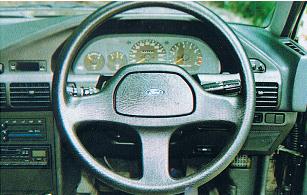
The dashboard was disappointing (see Picture) it is exactly the same as lower end Lasers with no effort at all to make it “sportier”. The seat cushions are hard but comfortable, especially the semi-bucket front seats.

Technical bits:

I just know the basics of the mechanical bits when my family owned the car. The engine is 1839cc 16v DOHC EFI engine that is the most powerful of 1800cc class ever in a locally Assembled car back in 1990. It has 103kw (140hp)@6500rpm and usable torque of 163Nm of 4700rpm. As a comparison, the BMW 318i back then is only 115hp.

The following was what I learned at the later part of my life. The brakes are 4 discs with front being ventilated. At that time, it was very advanced, in the era of Front Discs and rear Drums brakes found in most cars. The suspension is very advanced which is pioneered by Ford (1st seen in early 80s first generation Ford Laser and Mazda 323). It’s all round McPherson Struts with front and rear anti-roll bars with “dual-lateral links” at the rear. I also learned that the TX3 came with “Sports-suspension pack with stiffer springs and harder shocks”. Hence, it explained the hard, uncomfortable ride…


Brief specifications:

Engine:

1) inline 4cyl DOHC 16v 1839cc EFI

2) Bore & Stroke of 84x85mm and compression ratio of 9:5:1.

3) Max Power: 140ps (103kw) @ 6500rpm

4) Max Torque 163Nm@4700rpm

Transmissions:

5 speed manual

1st: 3.307

2nd: 1.833

3rd:1.310

4th:1.030

5th:0.795


Suspensions: Independent, McPherson Struts front and rear (fr & rr), Fr and rr anti-roll bars with dual-link lateral arms at rear, All round dampers and springs (duh!).

Brakes: See review above.


Dimensions: (all milimetres)

Length: 4270

Width: 1695

Hight: 1375

Wheelbase: 2500

Front track: 1430

Rear track: 1435

Weight: 1015kg

Wheels: White painted alloy rims with 185/60R14 tyres.


Fuel Consumption: 8L/100km averaged.

Fuel tank Capacity: 55Litres


Performance:

See review above.

Price: RM56,000 back in 1990. This year (2006), a used 1991 unit in tip top condition with 2 owners up for RM8,000 only (from The Star Metro Classifieds Aug 2006). Pay RM16,000 MAX for 1994 last models even in top condition with low mileage and 1 owner.


What to look out for:

1)Abused unit with Accident damages, beware of Cut and Shut units.

2) Rust in roof (weld spot area), rear hatch area, under and side of door or rust in chassis

3)Avoid high mileage car as it means time for Overhaul.

4) The interior is well built and hardy so should not be any problem.

5) Avoid turbo or engine conversion cars as it spells higher maintenance and parts.

6) The TX3 initially came in black only, from 1992 onwards, it has a mild Facelift along Red, white and Green colour added...

7) BEST if it’s less than 3 owners, mileage below 250000kms, service history (if applicable), original engine with little or no modifications, original paint is a BONUS (but for 12-16 yrs old car, very hard to find one).


Battle of two used 1.8 sedans

My friend is thinking of getting his own car in 1 yrs time. He set RM60k as

my budget. He will be buying
a used car
(more choices)! He has narrowed down to 2 strong candidates.


1) Audi A4 1.8 20v Non-turbo 2000,


2) Nissan Sentra

1.8GXE 2002.


After an extensive research, here are brief comparisons btw the 2.

1) Nissan Sentra 1.8GXE

i4 DOHC 16v 1769cc EFi FWD
Max power/torque: 128hp@6000rpm/163Nm@4400rpm
4 Speed Auto

Brakes: Front ventilated discs, RR discs, ABS

Wheels: 195/60R15, alloy rims

Dimensions (all mm except weight):
L/W/H: 4470/1695/1445
W`base 2535
Weight:1140kg
Turning circle: 9.2
Fuel tank cap: 50L

Performance:
Max Speed: 193km/h (friend tested), 0-100km/h 12secs

Equipments: 2x Airbags, ABS, Leather, V-Kool (standard on 1.8 Sentra),
MP3 player

Price:
New: RM112k (2002), Now: RM58k

2) Audi A4 1.8 20v -Non turbo-

i4 DOHC 20v 1781cc Bosch EFI FWD
Max power/torque: 125hp@5800rpm/173Nm@3950rpm
5 speed auto + DSP

Brakes: Fr and RR discs, Bosch ABS

Wheels: 195/65R15, steel rims

Dimensions:
L/W/H: 4480/1735/1415
W`base: 2615
Weight: 1240kg
T`circle: 11.1
Fuel tank cap: 62L

Performance:
Top speed: 200km/h (est)
0-100km/h 10.7s

Equipments:
Autocruise, Climate Control, 2x Airbags, ABS, Leather (opt), Elec. Adj
Seat...)

Price:
New: RM155k (2000)
Now: 58k

Note that both are tied in many areas, and the figures are VERY close.
Sentra lead by 3 hp but
Audi fights back with more torque. Audi is longer by just 1cm!!!
Weight, width and height are also VERY CLOSE! So as the wheels... Oh! Audi wins on gearbox, 5 speed vs 4 speed automatic and
Performance.

Oh! Audi also wins on Image... Drive both cars to 6 stars hotel and experience it yourself. In a meantime, Sentra wins on Resale value and reliability... Both tied on looks...
Maintenence is not an issue for Audi as it has longer service intervals and parts easily obtained from Chop shops (Junkyards)...

As for the used market value, both cars co-incidentally tied at RM58k apiece. But bear in mind that Audi A4 was priced at RM155,000 when new, while the Sentra was priced at RM112000 brand new...

So ladies and gentlemen, which is the right car to choose, he will be
using the car for at least 3 yrs.
Cast your vote... He! Will be getting the car early next yr... So
current value less about 10% - for sentra
(another yr depreciation) is 52k for Sentra. For Audi it`s 50k (less around 8k).

Opening ceremony...

This is my 1st posting. This blog is going to be a place where I post used cars reviews and comparison for cars in Malaysia. Indonesian and Singaporean used cars review are welcome, but I need your help, for Indonesian and Singaporean used cars reviews and comparisons I need you, fella visitors to submit your review and I will publish in this blog... Don't worry, I will acknowledge your name in the "article".

The reason I create this blog is that my friends found it difficult to obtain older cars reviews. Coincidently, I collected certain car magazines which dates back from 1992, so I felt that I'll be good if I posted some reviews on "used cars". Don't worry, I won't plagarise the article, but will only use the layouts of the article from 2 defunct magazines and just scan the pictures from the magazine(s).

Okay, let's celebrate the opening of this blog which by the way belongs to Jeff Lim (me).

*Pose for photographs...*

*Snips red ribbon*

*Crowd applause*

The subsequent posts will reflect my personal critics, thoughts, and lastly recommendations on used cars... So sit back, relax, and enjoy the ride! By the way, this site will be updated AT LEAST twice a week!